The "Yes, I Understand" Lie: Why I Started Building Class Echo to Save My Teaching Sanity
Most students pretend they understand to avoid embarrassment. I built Class Echo to create a safe space for honest feedback without the performance anxiety.
Picture this: you're standing in front of a classroom, pouring your heart and soul into explaining a complex tech concept something like asynchronous data fetching or nested React state management.
You pause, take a sip of water, look around the room, and ask the ultimate forbidden question:
"Does everyone understand so far?"
Right on cue, the entire class gives you synchronized nods. "Yes, instructor." "We understand." "Everything is fine."
Spoiler alert: they absolutely did not understand. In reality, most of them were completely lost.
As a facilitator at Harley Innovations Hub, I ran into this problem very early. I could see the confusion on some faces, but publicly, the response was always positive. That's when I realized something important about classroom psychology: Students will often pretend they understand just to avoid being the only person admitting they are confused. Nobody wants to raise their hand at 4:30 PM and say, "I have no idea what's going on."
The problem is, without an honest and safe feedback system, teaching starts to feel like operating in the dark. You can't improve a lesson if you don't know where students are struggling. So, being a frontend engineer, I did what any developer would do when faced with a communication problem: I opened VS Code and started building a solution. I call it Class Echo.
Moving From Vague Nods to Real Feedback
The philosophy behind Class Echo is simple: remove friction. I didn't want to create another bloated learning management system with long signup processes and unnecessary complexity. If students need to create an account just to say "the class is moving too fast," most of them simply won't bother.
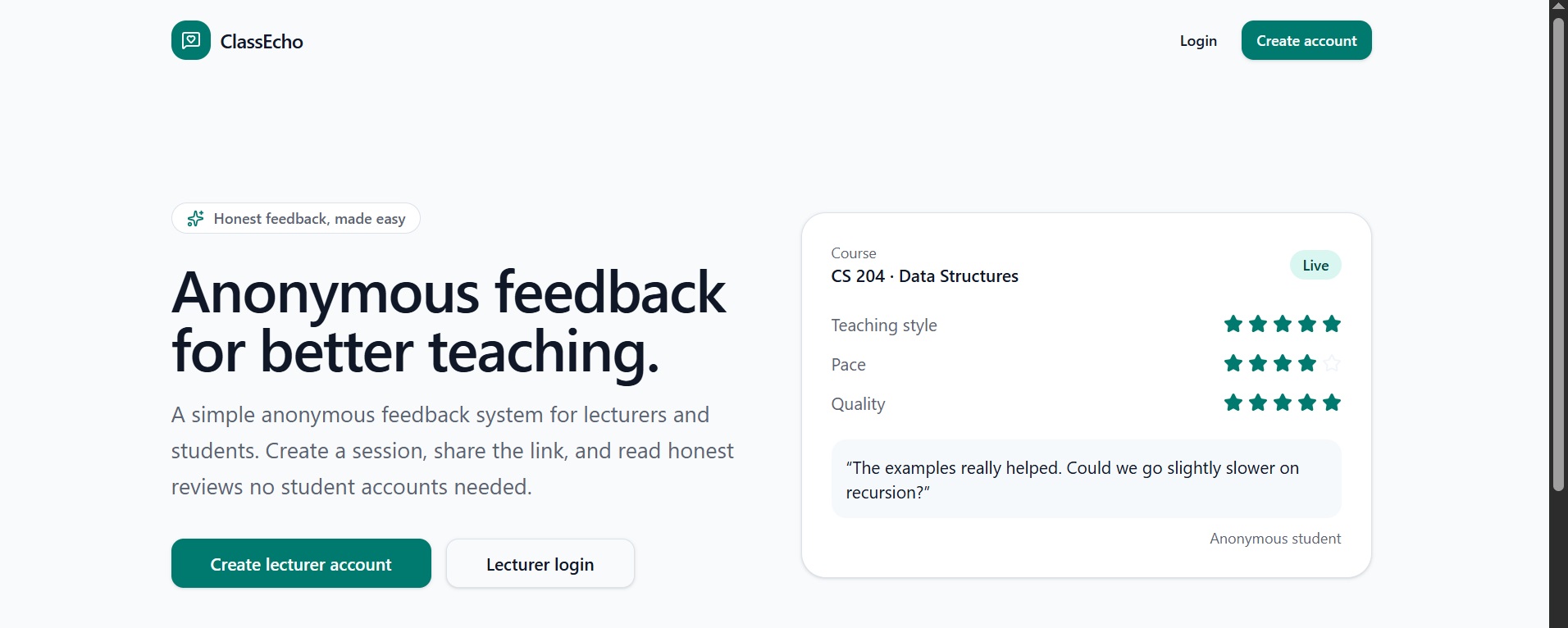
Instead, Class Echo allows instructors to generate a quick link where students can anonymously submit feedback in real time. To make the feedback actually useful, I avoided generic questions like "How was class today?" and focused on six specific areas instead:
Teaching Style: Is the teaching approach engaging and easy to follow, or does it feel disconnected and difficult to stay focused on?
Pace: Is the lesson moving at a comfortable speed, or does it feel too fast or too slow?
Quality: Are the explanations, examples, and overall delivery actually helping students learn effectively?
Simplicity: Are complex concepts being broken down into simpler ideas that are easier to grasp?
Understandability: After the lesson, do students genuinely understand the topic, or are they still confused but afraid to say it?
Complaints & Observations: A safe space for honest comments like "The screen share is blurry," "The AC is freezing," or "Can we please take a short break before our brains melt?"
The Stack Behind Class Echo
From a development perspective, I wanted Class Echo to feel fast, responsive, and easy to use on any device. The current stack includes: Frontend: React 19, TanStack Start, Tailwind CSS, TypeScript. UI Components: Shadcn/ui, Radix UI, Lucide Icons. Backend: Supabase (PostgreSQL + Auth). Build Tool: Vite with TanStack Router.
Mobile responsiveness was a huge priority because, realistically, most students are going to submit honest feedback from their phones during class. The experience needed to feel quick, smooth, and frictionless. Behind the scenes, feedback is aggregated into a private dashboard for instructors. The goal is to help teachers identify patterns over time — whether pacing is too fast, explanations are unclear, or certain materials are not connecting with students.
Still Building, Still Learning
Class Echo is still a work in progress, but it has already changed the way I think about teaching. Instead of relying on forced "yes, we understand" responses, I now have a better way to hear what students actually feel during sessions. My hope is that students will genuinely relate to it and feel comfortable enough to be honest without fear of embarrassment or judgment.
Because sometimes the most valuable thing a student can say is: "I'm lost." And as instructors, we should build environments where saying that feels completely okay.
If you're an educator, bootcamp instructor, mentor, or team lead running technical sessions, try replacing the usual "Does that make sense?" with an anonymous feedback system. The truth might sting a little at first, but honest feedback is one of the fastest ways to grow. And honestly, I'm excited to keep building Class Echo into something that truly improves the learning experience for both students and instructors.