AI Isn't Taking Your Job. The Developer Who Uses It Well Is.
The real shift isn't AI vs. developers — it's developers who've integrated AI into their workflow vs. developers who haven't.
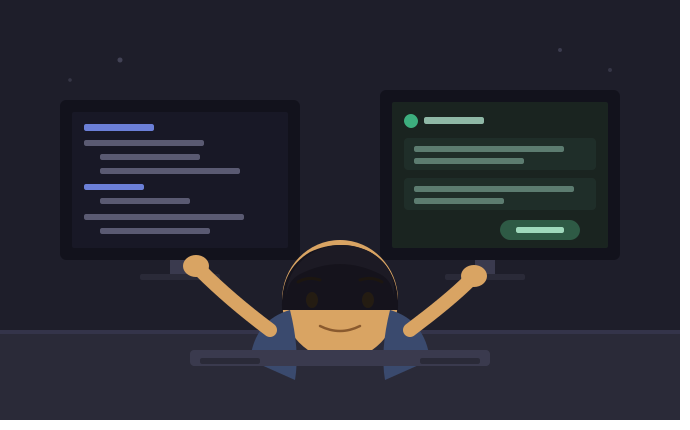
There's a version of this conversation that's mostly noise — doom threads about AI replacing programmers within five years, hot takes from people who've never shipped a feature with Copilot open. I want to skip past that and talk about what's actually happening on the ground, because it's more specific, and more useful, than "AI is coming for us."
The real shift isn't AI vs. developers
It's developers who've integrated AI into their workflow vs. developers who haven't.
That's the whole story. Not man vs. machine — it's two different developers applying for the same role, one of them shipping noticeably faster, and a hiring manager or client noticing the gap.
I've felt this shift directly. Debugging a TanStack Router SSR mismatch used to mean hours of manually tracing render output between server and client. Now I can describe the symptom, get a shortlist of likely causes ranked by probability, and verify the right one in minutes instead of hours. The debugging instinct still has to be mine — knowing which suggestion actually fits my route structure took experience, not a prompt. But the search space narrowed dramatically.
That's the pattern worth paying attention to: AI doesn't replace the judgment. It compresses the time between "something's wrong" and "I understand why."
What AI is actually good at (and bad at)
To use these tools well, you need an honest read on their limits.
Strong at: boilerplate, syntax recall across languages you don't touch daily, first-draft test cases, explaining unfamiliar error messages, summarizing documentation, refactoring suggestions once you've defined the target shape.
Weak at: understanding the actual constraints of your system — your specific hosting setup, your team's conventions, the business reason a feature has to work a certain way. It will confidently suggest a fix that's syntactically perfect and contextually wrong, and it won't flag that for you. You have to.
This is exactly why the developers who benefit most aren't the ones blindly accepting suggestions. They're the ones who already understand the problem well enough to evaluate the output critically — and use AI to move faster through the parts they've already mentally solved.
The skill that's actually becoming valuable
Prompting well is a small part of this. The bigger skill is the same one that's always mattered: knowing what question to ask.
If you don't understand why an SSR mismatch happens, no amount of AI assistance will help you debug one efficiently — you'll paste error messages without context and get generic answers back. If you do understand it, you can describe the actual symptom precisely, and the tool becomes genuinely fast.
In other words: AI raises the ceiling for developers who already have strong fundamentals, and it's far less useful — sometimes actively misleading — for developers who don't.
That's the uncomfortable part of this conversation that doesn't get said enough. The tools aren't a substitute for understanding your stack. They're a force multiplier on understanding you already have.
What this means practically
If you're early in your career, this isn't a reason to panic — it's a reason to be deliberate. Use AI tools while you're learning, but don't let them replace the parts of learning that build judgment: reading error messages slowly, understanding why a fix works and not just that it works, building your own mental model of how your framework behaves under the hood.
If you're further along, the move is integration, not resistance. The developers I see moving fastest right now aren't the ones who've memorized more syntax. They're the ones who've figured out where AI shortens their loop — code review prep, test scaffolding, documentation, first-pass debugging — and where it doesn't, and they haven't blurred that line.
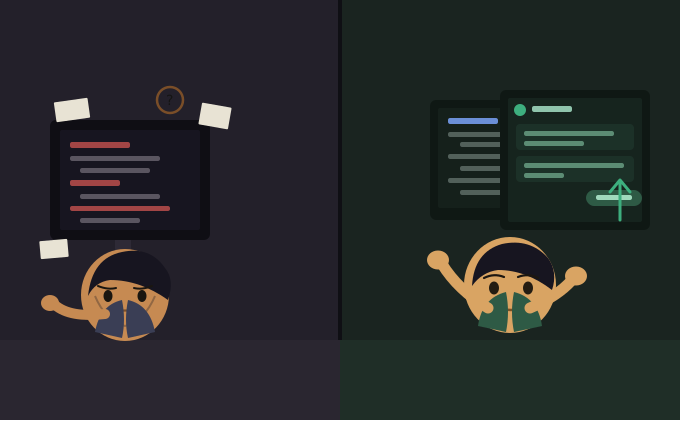
AI isn't going to write your portfolio, decide your project architecture, or know that your client actually needs fee management bundled with result publishing instead of two separate products. That judgment is still yours. The job isn't disappearing. It's shifting toward the developers willing to treat AI as infrastructure rather than either a threat or a crutch.
That shift is already happening. The only real question is which side of it you're building your skills for.
Currently building Gradifyre, a school management platform for Nigerian schools — and yes, AI tools are part of how it gets built.